
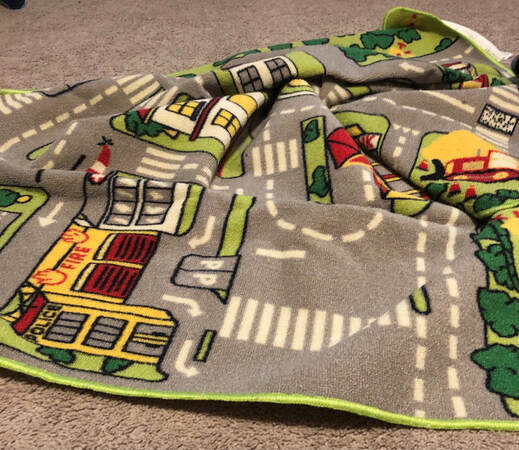
 The mountains or a messy rug? The mountains or a messy rug?
|
Reflect on the following question: - Based on your experiences working/being with children, explain about the way you discover and see children’s interests at child care centres. Submit your answer (in less than 150 words) to the Blog and join the ongoing discussion in the field of Early Childhood Education |
Observing Closely
By Zahra Rahbari
Funds of Knowledge (FOK)
The story begins once an educator observes a child trying to put a city driving rug on the floor unevenly. The educator asks if the child needs help to flatten the rug. It seems the child views the messy carpet differently: “I want it this way. These bumps are mountains,” as he declares excitedly and runs to get some more toys for his big project. After realizing the child’s idea, the teacher feels as amazed as the child and wonders whether this child’s FOK was the basis for the child’s project (e.g., going to the mountains often). Also, the educator wonders what other possible mediums have shaped this child’s artifact (e.g., sociocultural aspects such as his personal experiences: his Identity).
Funds of Knowledge (FOK) and Funds of Identity (FOI) Incorporation
According to Hedges, Cullen and Jordan (2011), FOK is defined as the foundations of knowledge, such as skills, information and procedures that pave the ways of thinking and learning. In addition, a diverse cultural population of children at school calls for building Funds of Identity (FOI), children’s sociocultural systems, through which FOK will be enriched (Joves, Siques & Esteban-Guitart, 2015). Joves et al. emphasized further that FOI in children improves the FOK by highlighting children’s interests. However, not necessarily do these two funds align with each other. Joves et al. explained finding and incorporating children’s creative interests is the best way to connect these two funds.
Final Thoughts
On a final note, to better understand a child’s FOI, the child’s creative works must be incorporated into teaching. As such, in realizing children’s interests, an educator has to be responsive, communicative and observant enough to recognize children’s interests beyond the normal practice of early education, child-centred, play-based curriculum and setting (Curtis & Carter, 2008; Hedges et al.). Moving from normalities to new practices calls for a change: a theoretical framework based on discovering and seeing children’s interests (Hedges et al.; MacDonald, 2018).
References
Curtis, D., & Carter, M. (2008). Learning together with young children: A curriculum framework for reflective teachers (1st ed.). Redleaf Press.
Hedges, H., Cullen, J., & Jordan, B. (2011). Early years curriculum: Funds of knowledge as a conceptual framework for children’s interests. Journal of Curriculum Studies, 43(2), 185-205. https://doi.org/10.1080/00220272.2010.511275
Joves, P., Siques, C., & Esteban-Guitart, M. (2015). The incorporation of funds of knowledge and funds of identity of students and their families into educational practice. A case study from Catalonia, Spain. Teaching and Teacher Education, 49, 68-77. https://doi.org/10.1016/j.tate.2015.03.001
MacDonald, S. (2018). Finding the Spark. Youtube. https://www.youtube.com/watch?v=NnTkFtak4Yg
The story begins once an educator observes a child trying to put a city driving rug on the floor unevenly. The educator asks if the child needs help to flatten the rug. It seems the child views the messy carpet differently: “I want it this way. These bumps are mountains,” as he declares excitedly and runs to get some more toys for his big project. After realizing the child’s idea, the teacher feels as amazed as the child and wonders whether this child’s FOK was the basis for the child’s project (e.g., going to the mountains often). Also, the educator wonders what other possible mediums have shaped this child’s artifact (e.g., sociocultural aspects such as his personal experiences: his Identity).
Funds of Knowledge (FOK) and Funds of Identity (FOI) Incorporation
According to Hedges, Cullen and Jordan (2011), FOK is defined as the foundations of knowledge, such as skills, information and procedures that pave the ways of thinking and learning. In addition, a diverse cultural population of children at school calls for building Funds of Identity (FOI), children’s sociocultural systems, through which FOK will be enriched (Joves, Siques & Esteban-Guitart, 2015). Joves et al. emphasized further that FOI in children improves the FOK by highlighting children’s interests. However, not necessarily do these two funds align with each other. Joves et al. explained finding and incorporating children’s creative interests is the best way to connect these two funds.
Final Thoughts
On a final note, to better understand a child’s FOI, the child’s creative works must be incorporated into teaching. As such, in realizing children’s interests, an educator has to be responsive, communicative and observant enough to recognize children’s interests beyond the normal practice of early education, child-centred, play-based curriculum and setting (Curtis & Carter, 2008; Hedges et al.). Moving from normalities to new practices calls for a change: a theoretical framework based on discovering and seeing children’s interests (Hedges et al.; MacDonald, 2018).
References
Curtis, D., & Carter, M. (2008). Learning together with young children: A curriculum framework for reflective teachers (1st ed.). Redleaf Press.
Hedges, H., Cullen, J., & Jordan, B. (2011). Early years curriculum: Funds of knowledge as a conceptual framework for children’s interests. Journal of Curriculum Studies, 43(2), 185-205. https://doi.org/10.1080/00220272.2010.511275
Joves, P., Siques, C., & Esteban-Guitart, M. (2015). The incorporation of funds of knowledge and funds of identity of students and their families into educational practice. A case study from Catalonia, Spain. Teaching and Teacher Education, 49, 68-77. https://doi.org/10.1016/j.tate.2015.03.001
MacDonald, S. (2018). Finding the Spark. Youtube. https://www.youtube.com/watch?v=NnTkFtak4Yg
|
|
© 2023 by eceprofessionaldevelopment.com